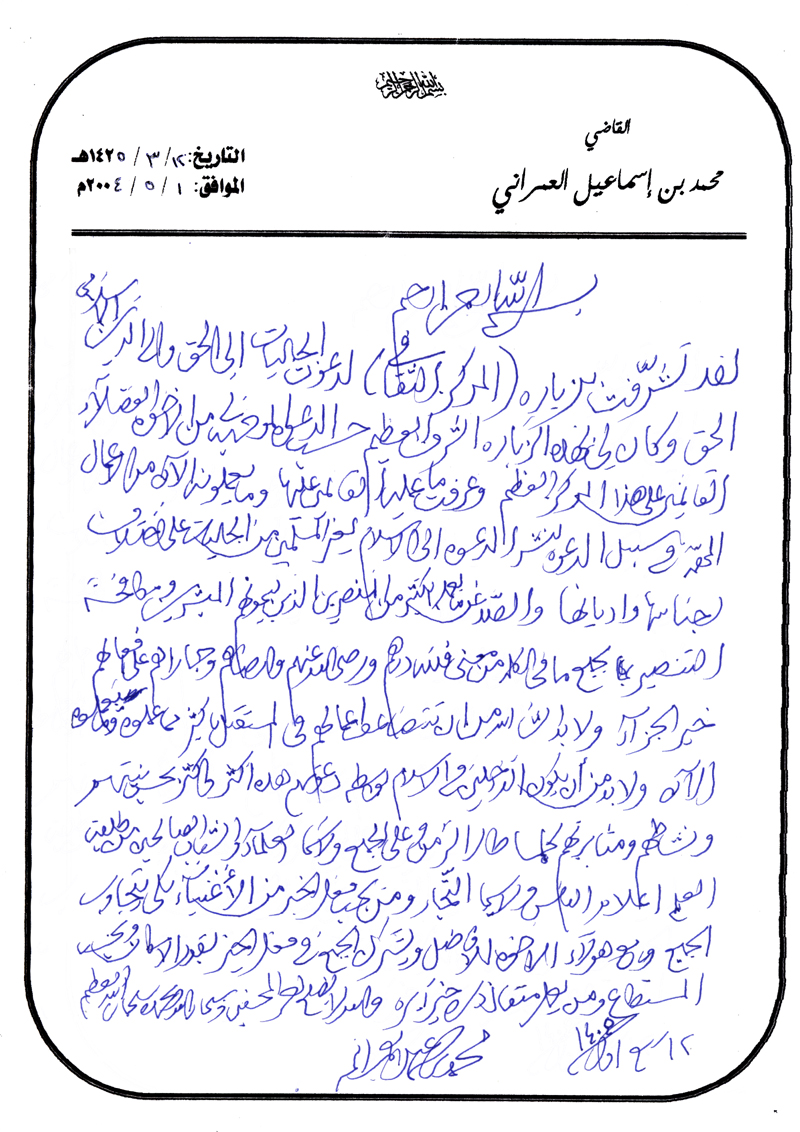
This visit was a great honor for me, as I was invited by the esteemed brothers in charge of this great center.
Organization: Presidency of the Republic
About:
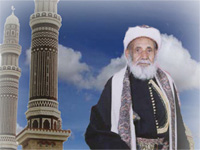
He is: Abu Abd al-Rahman, the learned judge, jurist, defender of the Sunnah, suppressor of innovation, master of the sciences—who devoted himself to knowledge, teaching, and issuing legal opinions at all times: Muhammad ibn Ismail ibn Muhammad ibn Muhammad ibn Ali ibn Husayn ibn Salih ibn Shayi' al-Umrani, born and raised in Sana'a. He was born in Rabi' al-Awwal 1340 AH.
Judge Muhammad ibn Ismail became known as al-Umrani, even though he was born, raised, and educated in Sana'a. The reason for his being known as al-Umrani is that his family originated from the city of Amran. The first of his family to move to Sana'a was his grandfather, Judge Ali ibn Husayn ibn Salih ibn Shayi' al-Umrani, during the reign of Imam al-Mansur al-Husayn (1139-1161 AH). This grandfather was the first to settle in Sana'a in the twelfth century AH (after the Hijra of the Prophet Muhammad, peace and blessings be upon him and his family), and he was the first of his family to pursue religious studies.
The name "Al-Amrani" became his and his descendants' proper name to this day, and they are not known by it without it, as it refers to their ancestral homeland. However, they are currently considered residents of Sana'a.
The family of the subject of this biography is a distinguished family in the field of knowledge, deeply rooted in virtue, righteousness, and judicial service. His ancestors contributed to the dissemination of knowledge, striving in this endeavor through teaching, guidance, and writing. The eminent judge, Muhammad ibn Ali al-Amrani, was one of the most prominent students of the renowned scholar and judge, Muhammad ibn Ali al-Shawkani. Al-Shawkani said of him in his book, Al-Badr al-Tali’: “He excelled in all the fields of independent legal reasoning (ijtihad), and became one of those who acted upon evidence and did not pay heed to hearsay. He attained a lofty position in knowledge, possessing a sharp mind, quick understanding, keen perception, and penetrating insight. His like is rarely found in this era, yet he was humble, detached from worldly affairs, and did not concern himself with the superficial embellishments of others far inferior to him, such as improving his appearance. He did not engage in the kind of posturing that resembles the outward display of knowledge. May God increase his benefits and make his knowledge beneficial. He heard from me most of the six major hadith collections, as well as Al-Adud, Al-Kashshaf, Al-Mutawwal, and their commentaries, among other books.”
Judge Muhammad ibn Ali al-Amrani is a model of the members of this distinguished family, renowned for their scholarship and piety. They were among their people and in their communities like stars among their contemporary scholars, and like beacons of guidance in knowledge, virtue, righteousness, and reform. He said in his book, Nuzhat al-Muhtaj: “See the biography of the subject of this biography. He is from a family that loves the Qur’an, the science of the Sunnah, and acting upon it.” Our esteemed Sheikh, the learned Judge Muhammad bin Ismail Al-Amrani - may God preserve him - speaks about the beginning of his pursuit of knowledge, saying: Encouraged by the elders who knew me from among the judges and scholars, who told me: “You are the son of Judge Ismail bin Judge Muhammad… Your grandfather was one of the great scholars of Sana’a, as was your father’s grandfather,” to motivate me to seek knowledge and join the ranks of scholars. With this encouragement, my soul yearned for knowledge, so I hastened to enroll in Al-Fulaihi Primary School when I was seven years old. I learned the Holy Quran from the teacher: Muhammad Al-Nu’mani and others, and I learned - in addition to the art of recitation - summaries of sciences represented in the curriculum of Al-Fulaihi Primary School, which are: ethics, grammar, calligraphy, composition, arithmetic, geometry, geography, and health, and I received a certificate from the school for that. I then moved to Al-Islah School on the day it opened, and I took all of the aforementioned primary summaries there, but it was more advanced and higher than the first. At the end of the year of my entry into this school, I left it with a certificate higher than the first, and this certificate that I obtained with my colleagues in this school was the first certificates given to its graduates, and it was the first batch to graduate from it.